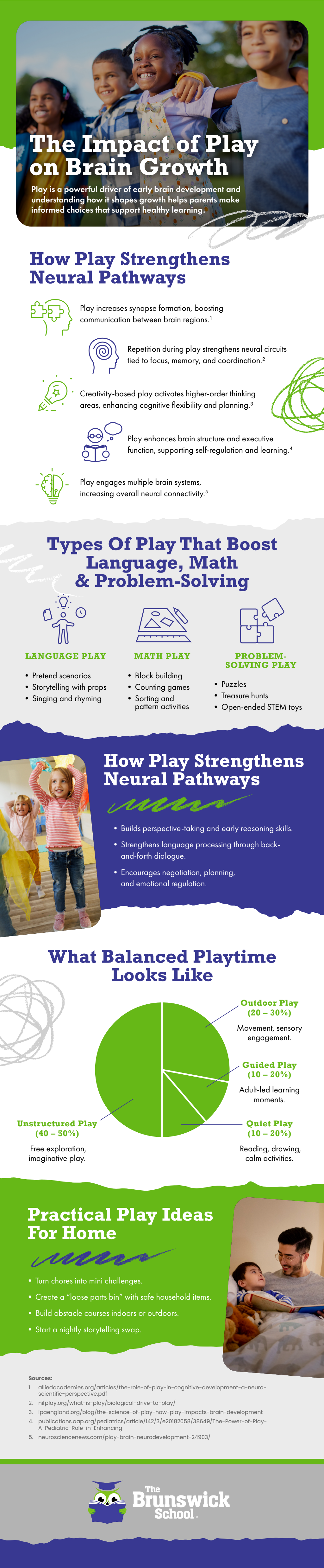

Play is far more than just fun time for children. It is an essential part of how young minds develop and learn about the world around them. While early academics are often emphasized, play supports foundational skills that underlie later success in school and life. Encouraging active engagement, curiosity, and experimentation, play creates a natural atmosphere for children to build confidence and resilience as they navigate new experiences.
At its core, play nurtures cognitive growth. When children explore freely, they engage multiple areas of the brain, connecting ideas and strengthening the pathways that support attention, memory, and executive function. This process of active exploration helps young learners not only retain information but also understand how to apply it in meaningful ways. Through play, a child’s brain is not simply crowded with facts, rather, it becomes a flexible and responsive system capable of adapting to new challenges.
Play also fosters social and emotional development. When children interact with peers, they learn how to communicate their thoughts, listen, and take turns. These exchanges teach perspective taking, empathy, and cooperation in ways that formal instruction alone cannot. Building relationships through shared goals and playful negotiation gives children a chance to practice conflict resolution and develop emotional regulation. These skills are essential for healthy social functioning and are cultivated organically through group play experiences.
Language development thrives in playful contexts. Whether it is inventing stories during dramatic play or singing songs together, children expand their vocabulary and begin to understand complex language structures. Math and logic grow through hands on activities, such as sorting objects or recognizing patterns in games. Problem solving skills are strengthened as children work through puzzles or construct imaginative scenarios. This blend of exploration and challenge builds a foundation for later academic learning while keeping engagement high.
Families and caregivers play a key role in supporting play. A balanced approach includes time for unstructured play, opportunities for movement and outdoor activity, and moments of guided exploration where adults prompt thinking with open ended questions. Providing diverse materials and moments for creative expression encourages children to take the lead in their own learning. Even small shifts in daily routines can create meaningful opportunities for play, offering children space to explore their own interests at a comfortable pace.
Investing in play sends a powerful message to children. Their ideas are valued, their curiosity matters, and lessons can be joyful. In doing so, adults help children build a love of learning that can last a lifetime, equipping them with the skills and confidence to meet future challenges with enthusiasm.
To explore more about how play supports healthy brain development, check out the accompanying resource from The Brunswick School, a provider of pre k 3 programs.