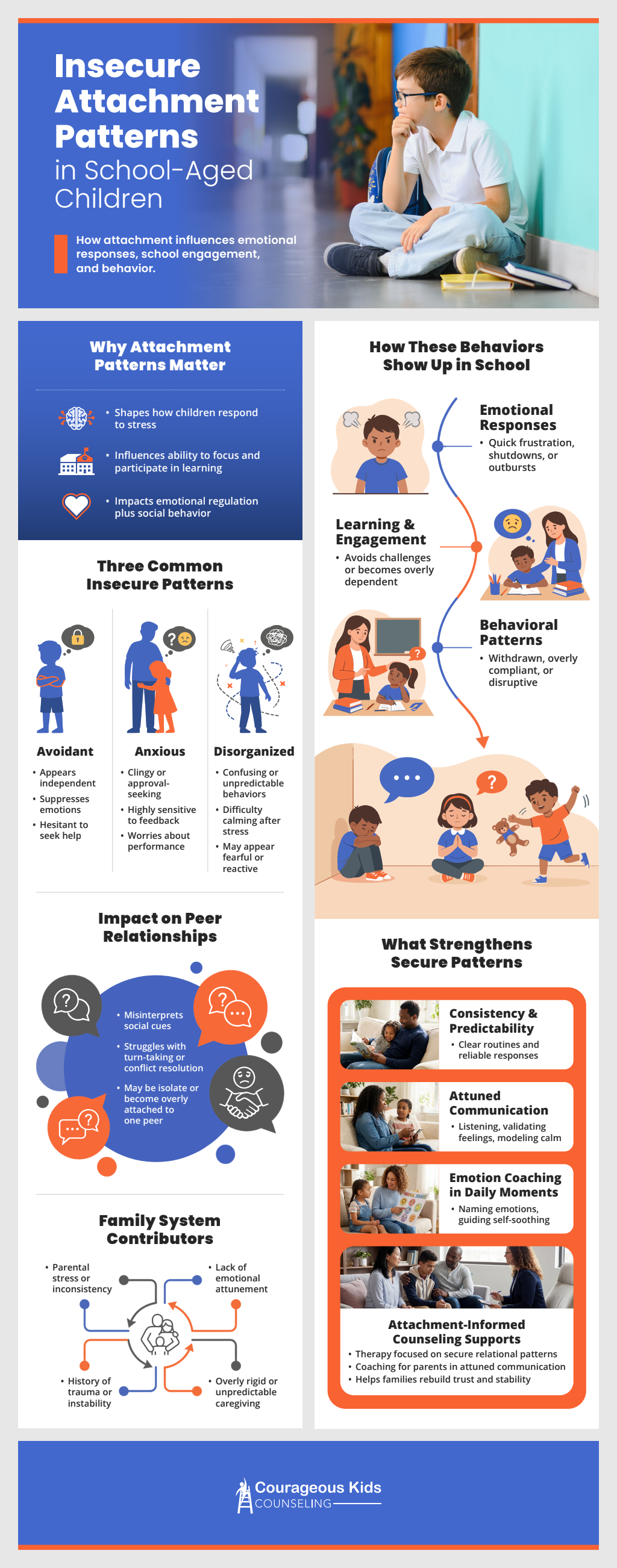

As children mature, the way they see themselves and relate to others is strongly shaped by their early relationships. By the time a child reaches school age, they have already developed expectations about emotional safety, communication, and whether adults can be relied on for comfort and support. These internal beliefs do not disappear when school begins. Instead, they continue to influence behavior, learning, and social interactions each day. While the infographic highlights visible attachment styles, there is a deeper emotional narrative unfolding beneath the surface.
Insecure attachment patterns often emerge in response to environments that felt inconsistent or emotionally unclear during early childhood. This does not suggest a lack of care or love from caregivers. In many cases, caregivers were navigating stress, exhaustion, or unresolved challenges of their own. Children adapt quickly to these conditions. Some learn that relying on themselves feels safer than depending on others. Others become especially alert to the emotions of people around them, working hard to preserve connection. Still others move back and forth between these strategies as they try to understand mixed signals in relationships.
Once children enter school, these patterns shape how they approach both learning and relationships. A child may avoid participating or taking academic risks because mistakes feel unsafe. Another may seem detached or distracted, not due to disinterest, but because much of their emotional energy is focused on maintaining a sense of security. Peer disagreements can feel overwhelming, and group activities may trigger uneasiness that the child cannot yet explain. These behaviors are not intentional disruptions. They are protective responses formed long before the child had the language to describe their inner world.
Positive change happens when adults offer consistency, patience, and emotional attunement. Growth begins when caregivers and educators take time to notice what a child may be feeling and focus on connection before correction. Simple practices such as offering choices, explaining transitions in advance, and validating emotions help build trust. Gradually, children start to reshape their expectations. They learn that adults can remain calm and reliable, that communication can feel safe, and that their emotional needs matter.
Caregivers are an essential part of this process, and they benefit from support as well. Learning about attachment patterns often brings awareness to personal stress, past experiences, and relational habits. Family therapy can offer a supportive environment where families explore these dynamics together while building tools that strengthen connection at home. When caregivers and children grow side by side, relationships become more stable, supportive, and resilient over time.
If you would like another way to explore how attachment patterns influence children during the school years, please review the related resource provided.