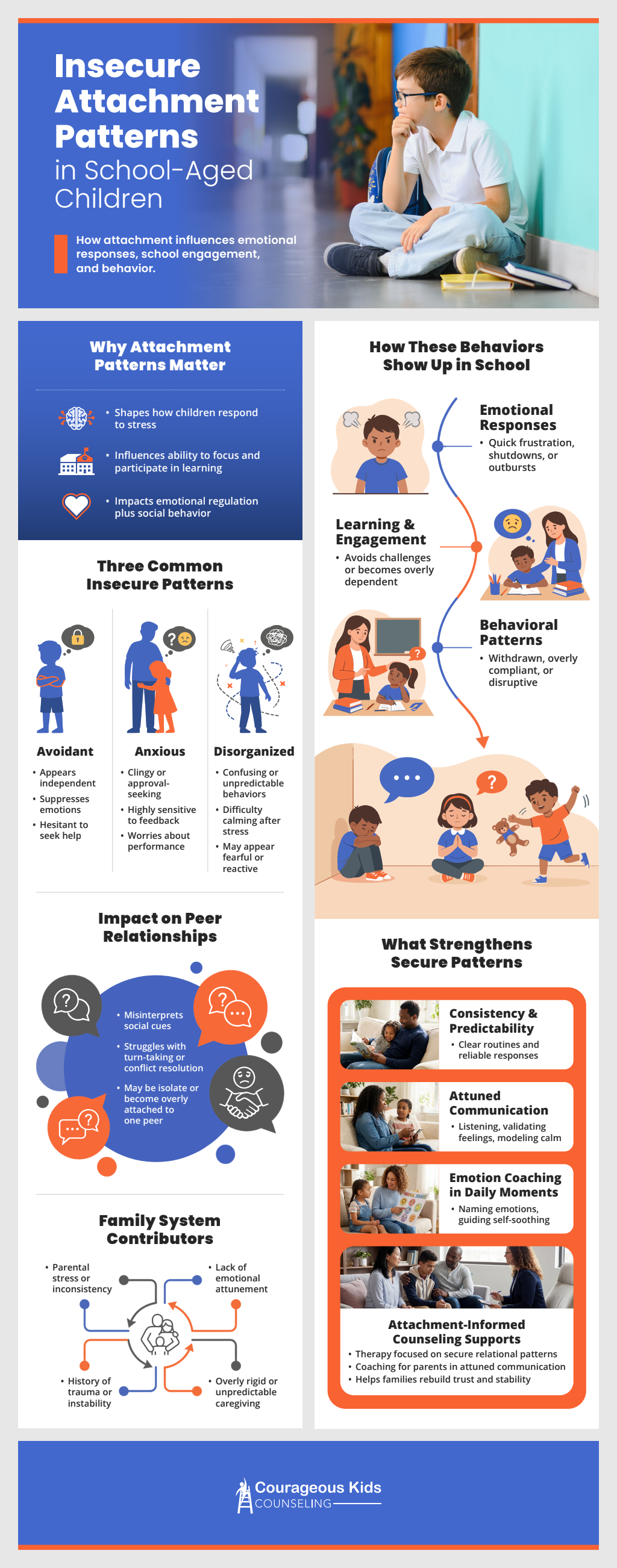
As children grow, their understanding of themselves and others becomes deeply shaped by the relationships that surround them. By the time a child enters school, they have already formed a sense of how safe it feels to reach out, how comfortable it is to express emotions, and whether adults can be counted on for support. These early impressions continue to guide their behavior in and out of the classroom. The infographic highlights several observable attachment patterns, but there is a wider emotional story that deserves equal attention.
Children who develop insecure attachment patterns often do so because their early environments felt unpredictable or emotionally confusing. It does not mean their caregivers lacked love. More often, caregivers were overwhelmed, stressed, or carrying their own unresolved experiences. Children learn quickly how to adapt to the emotional climate around them. Some discover that becoming very independent protects them from disappointment. Others stay highly tuned in to the reactions of others, hoping to maintain closeness. Some find themselves shifting between approaches as they try to make sense of mixed relational cues.
In the school setting, these internal patterns shape how a child approaches learning and interaction. A child may hesitate to take risks in the classroom because mistakes feel threatening. Another may appear disengaged, not because they don’t care, rather because focusing is difficult when emotional energy is spent on staying safe. Conflicts with peers can also feel bigger and more personal, and moments that require teamwork or sharing may stir up feelings that the child cannot yet name. At their core, these responses are protective habits formed long before the child had words to explain them.
Healing and growth become possible when adults create consistent, compassionate environments that honor the child’s emotional experience. A supportive approach involves slowing down, noticing what the child may be feeling, and connecting before correcting. Small moments like offering choices, preparing a child for transitions, or pausing to understand an emotional reaction can strengthen trust. Over time, children begin to rewrite what relationships feel like. They learn that adults can be steady, that communication can be safe, and that emotional needs will not be dismissed.
Caregivers also benefit from support during this process. Understanding attachment patterns often brings forward reflections about one’s own upbringing, stress levels, and relational habits. Child therapy can provide a gentle space to explore these experiences while learning strategies that build stronger connections at home. When children and caregivers grow together, the entire relational system becomes more resilient.
If you would like another way to explore how attachment patterns influence children during the school years, please review the related resource provided.