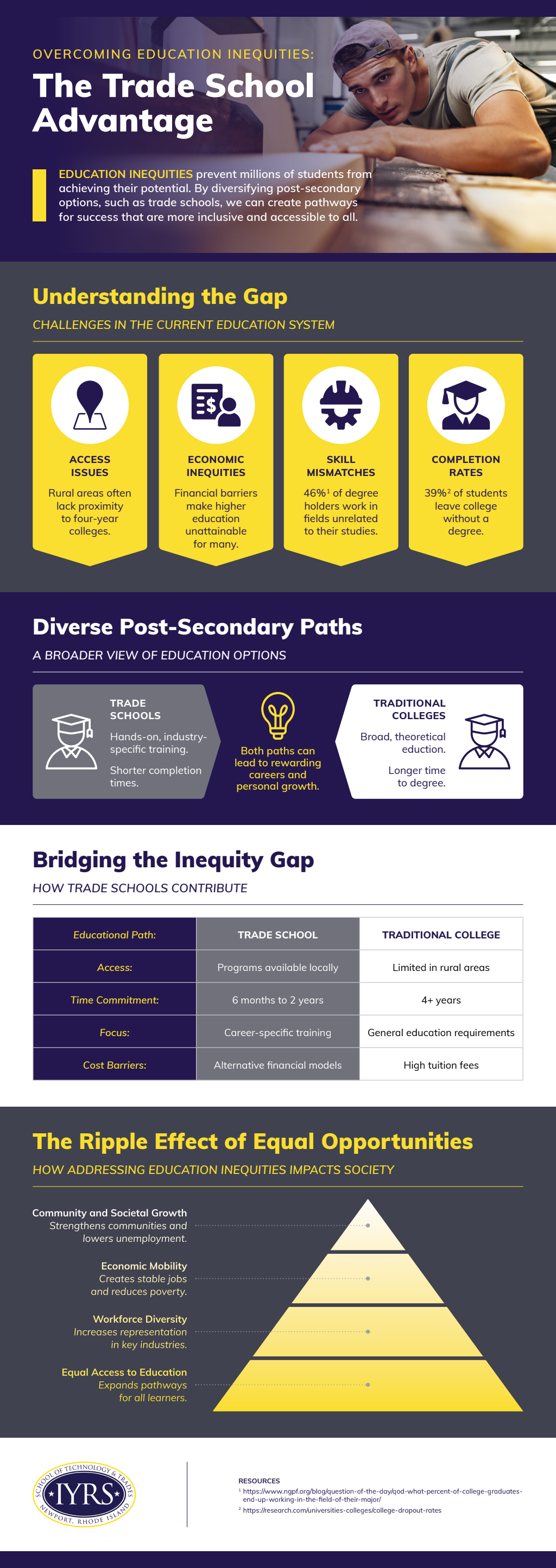

Educational inequality continues to limit opportunities for many students across the country. Economic challenges, limited access to schools, and uneven instructional quality make it difficult for individuals to pursue upward mobility through traditional academic pathways. While four-year universities are often seen as the standard route to success, this approach is not realistic or appropriate for everyone. For a large portion of learners, alternatives such as trade schools, apprenticeships, and community colleges offer practical, affordable, and effective ways to build a stable future.
Trade schools in particular have become an important resource for students seeking specialized, hands-on training. These programs offer focused instruction in fields such as healthcare, technical trades, and information technology. Unlike traditional colleges, which take a broader academic approach, trade schools emphasize skill development that directly aligns with in-demand careers. For underserved groups, this targeted training can significantly expand employment opportunities and improve long-term economic prospects.
However, trade education alone cannot fully resolve the longstanding challenges that shape educational inequality. Addressing these gaps requires a combination of strategies that respond to local needs. Mobile training units, online credentials, and partnerships between employers and schools can provide flexible options that extend beyond physical classrooms. These models ensure that students are not limited by geography or a lack of nearby resources.
Changing public perception is also important. Vocational education has often been misunderstood, despite its strong outcomes in job placement and career readiness. Highlighting successful graduates and improving awareness of modern trade careers can help students and families better appreciate the value of career-focused training.
Policy support plays a key role as well. Expanding financial aid, investing in trade program infrastructure, and encouraging industry participation in curriculum planning can help more students access meaningful training opportunities. Mentorship and career guidance also make a significant difference by helping learners understand their options and remain engaged throughout their educational journey.
There is no single solution to solving educational inequity, but increasing access to vocational pathways is a meaningful step. By elevating the visibility and availability of trade-focused education, we can create a more inclusive system that supports a wider range of learners and strengthens the future workforce.
For more on this, check out the accompanying resource from IYRS School of Technology and Trades, a marine tech school.